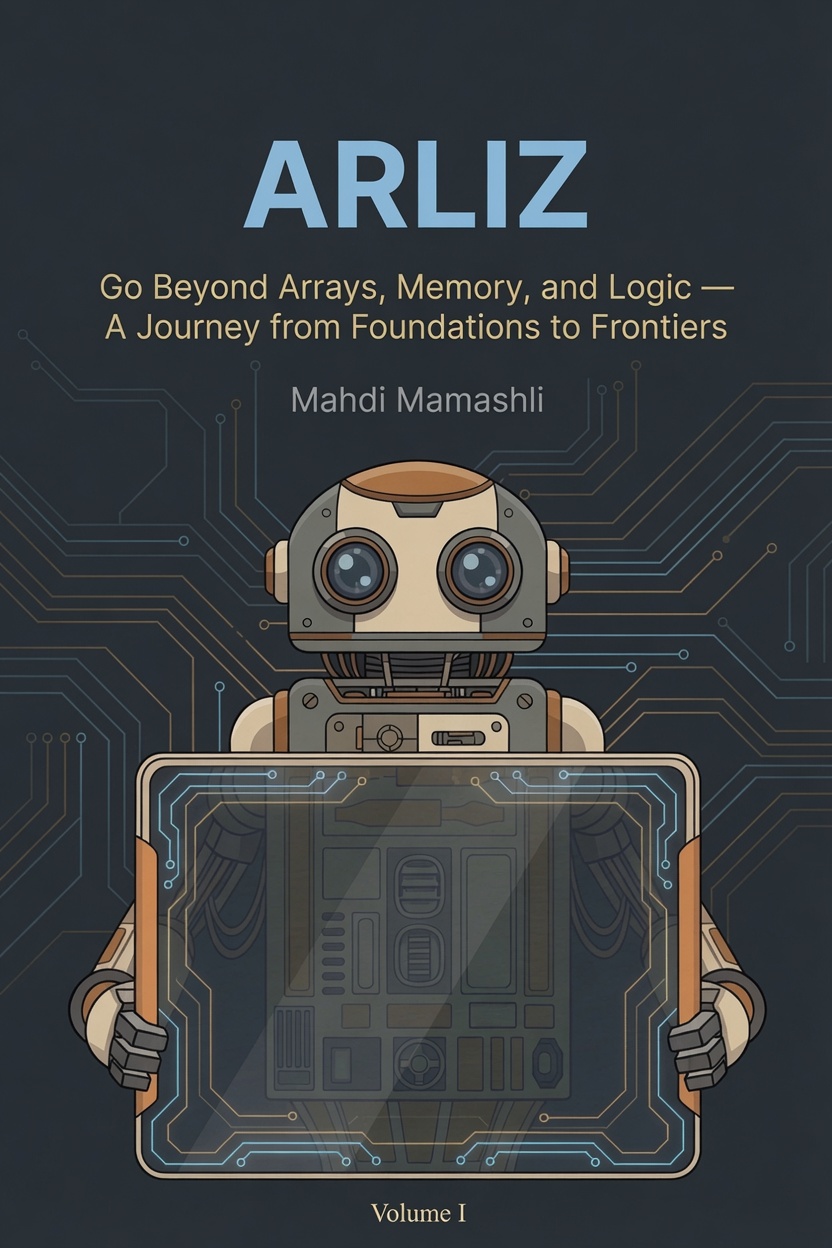
What is an array, really? —
One question, three volumes.
Not a reference. A single thread followed seriously, from a voltage difference across a transistor to tensor cores and quantum state vectors.
§ Preface
Not the syntax. Not the API. The thing itself.
Most programmers learn arrays the quick way: here is the syntax, here is how you loop over them, move on. Following the question further led through memory layout, cache hierarchies, transistor physics, and eventually to GPU tensor cores and quantum state vectors.
"Arrays, Reasoning, Logic, Identity, Zero" — a name that sounded right first; the acronym came after.
That path is long enough that it no longer fits in a single book. ARLIZ is organized as three volumes — each a complete stage of the same journey, readable on its own but part of one continuous line of reasoning.
This is not a reference book. It is not a gentle introduction. It is an honest attempt to understand one of the most fundamental structures in computing, from every relevant angle, grounded throughout in the physical reality of the machines that run our code.
It is also a living work. Errors get corrected, explanations get sharper, and each volume improves on its own schedule. If something is wrong, opening an issue is more useful than silence.
Mahdi Mamashli
The Work
Each volume depends on the one before it. Volume II assumes I. Volume III assumes both. The path runs one direction: voltage → hardware → arrays.
How information is encoded at all — voltage, binary switching, number systems, integers, floating point, characters, byte order, alignment, pointers, and serialization.
The hardware that turns encoded information into computation — logic gates, memory hierarchies, processors, pipelines, ISAs, SIMD, GPUs, and interconnects.
Arrays themselves, in full — theory, memory layout, every major variant, the structures and algorithms built on them, and the parallel and distributed systems that process them today.
Contributors
ARLIZ grows through community. Every correction, clarification, and chapter contribution is acknowledged and celebrated. Data pulled live from GitHub.
Community
ARLIZ grows through engagement. Report errors, suggest improvements, discuss concepts, or contribute content. Every voice sharpens the book.
Found a mistake, unclear explanation, or broken reference? Open an issue and help make ARLIZ more accurate for every reader who comes after you.
Open an Issue →Have a better explanation, a missing chapter idea, or a more elegant example? Share it. ARLIZ is shaped by the people who read it closely enough to care.
Start a Discussion →Write a chapter, add examples, improve LaTeX formatting, or expand the glossary. Read the contribution guide and submit a pull request.
Contribution Guide →